A South Dakota license plate stays with you when you sell a car and move to another vehicle, which is why the state calls itself a plate-with-owner state. That single rule covers most of what surprises new residents. You do not buy a new plate every time you change cars, you transfer the one you already have. The county treasurer’s office handles the paperwork, and the Department of Revenue sets the fees. A plate that is transferred, renewed or replaced follows the same record, so one document trail covers the whole life of the vehicle.
This page covers what a South Dakota plate actually costs, which plates exist, how the renewal calendar works, and what the two-plate law requires under SDCL 32-5-98. Every fee below comes from the Department of Revenue’s current fee schedule, and every form links to the official version. Use it before you visit the treasurer’s office so you arrive with the right papers and the right amount. Every section stands on its own, so you can jump straight to the part that matches your errand.
How to Apply for a South Dakota License Plate
South Dakota does not run a separate plate counter. The plate is issued as part of the title transaction, so the two applications are one form, and the county treasurer handles both at the same window. That is why the first step always starts with the title. Without a signed title there is no registration, and without a registration there is no plate. Buyers who expect a quick plate pickup at a state office usually lose a trip. The county treasurer in the county where the vehicle will be kept is the only office that can process the paperwork, collect the excise tax and hand over the registration.
- Get the title signed over: The seller signs the title, fills in the purchase price and the odometer reading, and hands you a bill of sale. Private sellers must give you a seller’s permit, which is free and valid for 45 days.
- Complete Form 1001: The Application for Motor Vehicle Title and Registration covers both the title and the plate. Every owner listed on the title must sign it.
- Bring proof of identity and insurance: A South Dakota driver’s license or ID, plus proof of insurance on the vehicle, is required at the counter.
- Pay the excise tax and fees: The 4% motor vehicle excise tax is calculated on the purchase price. Title, lien, technology and county fees are added on top.
- Get your plates: Smaller counties hand them over at the counter. Larger counties mail them, and a mailing fee applies when the plates ship separately.
Documents to Bring to the County Treasurer
Counties turn people away for missing paperwork more often than for missing money. The list is short, but every item is checked at the counter before the clerk starts the transaction.
- Signed title, with the seller’s signature notarized if the title requires it
- Bill of sale with the purchase price written in
- Photo ID, ideally a South Dakota driver’s license or state ID
- Proof of insurance for the vehicle being registered
- Odometer disclosure if the vehicle is being sold
- Payment for the excise tax and fees, or a check made out to the county
If a lender holds the title, bring the lender’s paperwork. An electronic lien is normal in South Dakota, and the county can see the lienholder in the state system, but the loan documents speed up the process.
What Happens If You Miss the 45-Day Window
Nothing catastrophic, but the cost climbs in three separate ways. Interest accrues first, then a one-time penalty lands, then the title late fee keeps adding up week by week. The rates sit in the fees table on this page, and all three run from the purchase date rather than the day you file. The 45-day clock matters more than most people expect. South Dakota gives you 45 days from the purchase date to title and register, and the state does not grant extensions. Interest and a one-time penalty apply once the deadline passes, and the title late fee rises every week until it caps.
What a South Dakota License Plate Looks Like
Standard plates carry the state name across the top and “Great Faces, Great Places” along the bottom, a slogan that has been on South Dakota plates since the 1990s. The design uses Mount Rushmore in the background and a blue band across the top. County names are not printed on the plate, but the numbering follows county-based series that the state assigns. The standard format is three letters followed by three numbers, printed in a plain sans-serif face. Specialized series use different prefixes, and personalized plates allow up to seven characters. A South Dakota plate carries no front-window sticker; the registration sticker goes on the rear plate, and the month and year tabs sit in the corners.
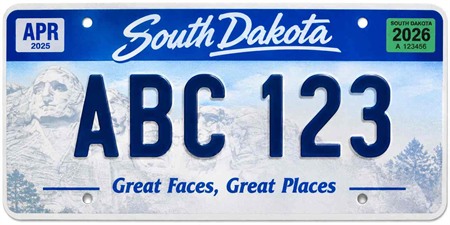
- Colors: blue band, white field, dark text
- Slogan: Great Faces, Great Places
- Sticker placement: rear plate, upper corners
- Plate size: 12 by 6 inches, standard US dimensions
- Material: embossed aluminum
Where the Plate Number Comes From
South Dakota assigns plate numbers in county-based series, which is why two cars registered in the same county often share a prefix. The prefix is not a random code. It identifies the series and, in older numbering, the county where the vehicle was first registered. The state moved to a centralised system years ago, so a car that changes counties keeps its number. The practical effect is that you cannot request a specific prefix for a standard plate. Personalized plates are the only way to choose characters, and even then the state rejects combinations that collide with an existing series.
Types of South Dakota License Plates
The state issues far more plate types than most drivers realize. The list below covers the categories a regular driver is most likely to encounter, with a link to the official page for each one.
| Plate type | Who it is for | Where to apply |
|---|---|---|
| Standard | Passenger cars, trucks, vans | Form 1001 |
| Personalized | Drivers who want custom characters | Form 1300 |
| Specialty | Emblem, Dignity sculpture, tribal, special interest | DOR specialty plates |
| Military and veteran | Veterans, active duty, National Guard | DOR military plates |
| Disabled | Drivers with a qualifying disability | DOR disabled plates |
| Historical | Vehicles 30 years or older | DOR historic vehicles |
| Motorcycle | Motorcycles and autocycles | DOR motorcycles |
| Trailer | Trailers and semitrailers | DOR trailers |
Specialty and Organizational Plates
A specialty plate is sponsored by an organization, a cause or a state programme, and the plate usually carries a small annual contribution on top of the normal registration. Emblem plates, the Dignity sculpture plate, tribal plates and firefighter plates all sit in this group. The organisation has to be approved before its plate can be ordered. That means a new nonprofit cannot simply request a design and hand it to a clerk; the state reviews the design, the eligibility rules and the contribution amount first. Once approved, the plate appears in the state’s list and any qualifying driver can request it.
Disabled, Veteran and Historical Plates
These three categories carry eligibility checks that the standard plate does not.
- Disabled plates and permits: a medical certification is required. The plate removes the need to hang a temporary placard, and the permit version is useful for drivers who move between vehicles.
- Veteran and military plates: proof of service is required, typically a DD-214 or a current military ID. Disabled veteran plates add a service-connected disability requirement.
- Historical plates: available for vehicles that meet the state’s age threshold, with driving restrictions attached. A historical plate is cheaper than a standard registration, but the vehicle is limited to occasional transportation, displays, parades and similar hobby use.
Each of these has an official page linked in the table above, and each links back to the county treasurer for the actual transaction.
South Dakota License Plate Fees
Fees come in two parts, a one-time excise tax at titling and recurring registration costs. The table below uses the amounts published by the Department of Revenue.
| Fee | Amount | When it applies |
|---|---|---|
| Motor vehicle excise tax | 4% of purchase price | One time, at title and registration |
| Title fee | $10 | One time |
| Lien notation fee | $10 | When a lender holds a lien |
| Duplicate title fee | $10 | Replacement title |
| Technology fee | $2 | Added at titling since 1 July 2025 |
| Solid waste fee | $1 | Added at titling |
| Highway Patrol fee | $1 | Added at titling |
| Plate mailing fee | $12 | When plates are mailed |
| Registration mailing fee | $2.50 | When renewing by mail |
| Late title application | $1 per week after 45 days, max $50 | Late titling |
| Late payment interest | 1% of tax or $5 per month, whichever is greater | After 45 days |
| Late payment penalty | 10% of tax or $10, whichever is greater | After 60 days |
| Online payment processing | $0.95 e-check, 2.5% debit or credit card, 3.95% commercial card | Online and kiosk renewals |
| County wheel tax | Varies by county | Added to registration |
| Registration fee | Based on weight and model year | Every year |
| Temporary permit | $1 per day, minimum $5 | 5 to 15 day permit |
First-Time Registration
Take a 2017 half-ton pickup bought from a private seller in Minnehaha County, financed through a local bank. The buyer pays the excise tax at the counter rather than to the seller, and the lender’s lien is noted on the title in the same visit. Registration is calculated from the truck’s weight and model year, so the county adds that figure once the tax is settled. The table shows where each dollar goes and which lines are one-time costs. Only registration and the county wheel tax come back every year; everything else is paid once, when the title changes hands.
| Line item | Amount |
|---|---|
| Purchase price | $18,500 |
| Excise tax at 4% | $740.00 |
| Title fee | $10.00 |
| Lien notation | $10.00 |
| Technology fee | $2.00 |
| Solid waste fee | $1.00 |
| Highway Patrol fee | $1.00 |
| Registration, weight based | Varies, roughly $80 to $180 |
| County wheel tax, if applicable | Varies |
| Due at the counter | About $845 to $945 |
What You Pay Every Year After That
The excise tax and the title fee are one-time costs. From the second year onward you pay registration, any county wheel tax, and the mailing or processing fee if you renew by mail or card. Registration itself trends downward as a vehicle ages in some weight classes, which is why a ten-year-old car often renews for less than a new one. The state publishes the weight and model-year schedules, and the county treasurer applies them; there is no negotiation and no loyalty discount. If the vehicle is financed, the lien stays on the record until the lender releases it. South Dakota has used electronic titles since October 2012, so the paper title arrives only after the loan is paid off. The South Dakota vehicle fees page includes a working calculator for your own numbers.
When Your South Dakota Plate Renews
South Dakota does not renew every plate in January. The renewal month is tied to the first letter of your last name, which spreads the workload across the year and means your renewal month never changes.
| First letter of last name | Renewal month |
|---|---|
| A, B | January |
| C, D, E | February |
| F, G, J | March |
| H, I, O | May |
| K, L | June |
| M, N | July |
| P, Q, R | August |
| S | September |
| T, U, V, W, X, Y, Z | November |
Renewing Online vs at a Kiosk
Both options avoid the counter queue, and both need a valid South Dakota driver’s license or ID plus a payment method. Online renewal through my605drive works from any browser. The system pulls every vehicle tied to your record, you select the ones you want, and the new registration prints at home or mails out. Payment processing and mailing charges apply, and the fees table above lists them. A DMV Now kiosk does the same job in person and dispenses the sticker on the spot. Kiosks are installed in Sioux Falls, Rapid City, Pierre, Aberdeen, Mitchell, Watertown and Yankton, mostly inside grocery stores and county buildings.
Two Plates vs One Plate in South Dakota
South Dakota requires two plates on most passenger vehicles. SDCL 32-5-98 states that a vehicle may not be operated without two number plates, and a violation is a Class 2 misdemeanor.
| Vehicle type | Plates issued | Notes |
|---|---|---|
| Passenger car, truck, van | Two, front and rear | SDCL 32-5-98 |
| Motorcycle | One | Rear only |
| Trailer, semitrailer | One | Rear only |
| Recreational vehicle | One | Rear only |
| Historical or collector | One | Parade and display use |
Standard Plate vs Personalized Plate
A standard plate leaves the county office with you, since the number comes from the next series in the stack. A personalized plate does not work that way. The characters you want may already belong to someone else, may read as offensive, or may be reserved for a plate series such as a specialty or tribal design. That is why the state reviews the request before anything is stamped. The review adds time, and a rejected request means starting over with a new combination.
| Standard plate | Personalized plate | |
|---|---|---|
| Characters | Three letters, three numbers | Up to seven characters |
| Approval | Immediate | DOR review |
| Form | Form 1001 | Form 1300 |
| Extra fee | None beyond registration | Plate fee plus registration |
| Transfer to a new vehicle | Yes | Yes, if the plate is still valid |
| Availability | Assigned by series | Must be checked before ordering |
Replacing a Lost, Stolen or Damaged Plate
A missing plate does not mean a new registration, and it does not mean a new number. South Dakota ties the plate to the owner, so the county treasurer issues a duplicate of the plate you already have. The reason matters. A stolen plate needs a police report first, a damaged plate usually needs the old one handed in, and a plate lost in a car wash needs an affidavit and nothing else. Driving without a readable rear plate is a misdemeanor under state law, so the replacement is not something to postpone until renewal. The form is short, the fee is paid at the counter, and the new plate usually arrives within a few weeks.
- Report a stolen plate to local police before applying, so the record shows the theft
- Complete the Affidavit for Duplicate License Plate or Validation Sticker, Form 1308
- Bring the affidavit and the fee to your county treasurer’s office
- Keep the remaining plate on the vehicle as the duplicate is made
- Destroy the recovered plate if it turns up later, since two active copies create confusion
If the plate is damaged but the number is readable, bring the damaged plate with you. Some counties want to see it before issuing a replacement.
Buying, Selling or Moving to South Dakota
Private sales generate most plate questions, and the answer usually comes down to the bill of sale and the 45-day window. The seller completes a bill of sale, Form 1025, signs the title, and prints a free seller’s permit through the my605drive portal. That permit lets the buyer drive legally for 45 days as the title work is completed. Failing to provide it is a Class 2 misdemeanor. Our South Dakota bill of sale page has a printable version and the fields buyers forget.
Dealer Sale vs Private Sale
- Dealer sale: A licensed dealer submits the title application on your behalf, collects the excise tax and hands over a temporary tag. You leave with a permit and the plates arrive later. The county never sees you, and the 45-day clock is the dealer’s problem rather than yours.
- Private sale: Every step lands on the buyer. You collect the signed title, the bill of sale and the seller’s permit, then take all three to the county treasurer. If the seller disappears without signing the title, the county cannot process the transfer, and fixing that needs a bonded title process that takes months.
- Seller’s duty after the sale: South Dakota asks private sellers to report the sale through the online portal so the state record stops showing them as the owner. Skipping that step leaves the seller exposed to parking tickets and tolls run up by the new owner.
- New residents: You get 90 days from arrival to title and license a vehicle. If your previous state charged more than 4% tax, South Dakota grants reciprocity and charges nothing extra. If your state charged less, you pay the difference.
- Where registration happens: The county treasurer handles it, not a state office. The South Dakota vehicle registration page lists what to bring, and the DMV office directory covers hours and locations for the larger counties.
Frequently Asked Questions
These are the questions the county treasurer and the Department of Revenue hear most often. Each answer covers the South Dakota rule in a short paragraph, with the official fee or deadline where one applies. If your situation involves a lien, a lease or an out-of-state title, call the county office before you drive over.
How much does a South Dakota license plate cost?
There is no separate plate fee for a standard plate. Titling adds the title, technology, solid waste and Highway Patrol fees plus the excise tax. Registration is billed separately by weight and model year, and the fees table above lists every amount.
Do I need a front license plate in South Dakota?
Yes. SDCL 32-5-98 requires two plates on passenger vehicles, one front and one rear. Motorcycles, trailers, recreational vehicles and historical plates are the main exceptions and use a rear plate only. Leaving the front plate off is a violation of that section.
How long do I have to register a car after buying it?
Forty-five days from the purchase date. The state does not grant extensions, and the clock starts on the day of sale rather than the day you file. Interest starts after day 45 and a penalty follows after day 60.
When does my South Dakota plate expire?
Your renewal month is set by the first letter of your last name. If your last name starts with J, your plates renew in March every year. The plate itself is replaced only when it is damaged or the design changes.
Can I keep my South Dakota plates when I sell my car?
Yes. South Dakota is a plate-with-owner state, so the plates stay with you. Transfer them to your next vehicle at the county treasurer’s office and bring the old plates with you. The number follows the owner, not the vehicle.